

Fingerprint Rejections: Why They Delay International Hiring, Visas and Licensing (and How to Avoid Them)
A rejected fingerprint card can push back hiring dates, visa applications, and licensing, and abroad the cost is rarely just one repeat appointment. Here is why prints get rejected, why it hurts more in international cases, and a practical checklist for applicants and HR teams.

A rejected fingerprint card can delay an international background check, potentially affecting hiring dates, visa applications, and professional licensing. Many rejections trace back to how the prints were taken or how the card was completed, not to anything about the applicant, and both can be checked before the appointment.
Not every rejection can be prevented, but when a set of prints is rejected, the cost is rarely just one repeated appointment. A new card may have to be taken, shipped, and resubmitted, and every later step, such as an apostille or a certified translation, moves back with it.
The Short Answer
- Many rejections come down to quality or paperwork. Poorly rolled prints, smudged ink, an out-of-date or non-standard card, missing fields, and dry or worn skin are among the usual reasons
- Abroad, a rejection costs more than an appointment. The card often travels by mail, so a repeat means re-taking the prints, re-shipping the card, and waiting again
- Delays stack. Apostille, translation, and the receiving office's own review all start after the check is back. A late record pushes every one of them
- Preparation reduces the risk. Confirm the card and route first, use an experienced technician, prepare your hands, and check the card before you leave
What a Fingerprint Card Rejection Actually Means
A fingerprint card rejection means the submission cannot be processed as sent. It does not mean there is a problem with the applicant's record. It generally falls into two groups:
- Print quality problems. The impressions are too light, too dark, smudged, incomplete, or out of sequence, so they cannot be read reliably
- Card and data problems. The card is not the right type, a required field is missing, entries are outside their blocks, or the card has been marked or damaged
The distinction matters because the fixes differ. Quality problems are fixed by better technique and preparation. Card problems are fixed by confirming the right card and checking it before it is sent.
Why Rejections Hurt More in International Cases
Inside the country that runs the check, a rejected set may mean returning to a fingerprinting site the next day. Across borders, the same event usually looks different:
| Where the time goes | Why it adds delay |
|---|---|
| Re-taking the prints | You need another appointment, and a fresh card, because the FBI says it requires a current fingerprint card |
| Shipping the card | From outside the U.S., FBI requests are normally sent by mail with the card, so each repeat adds postal time in both directions |
| Waiting for the authority | Processing times are set by each agency and can change. Check the current guidance before planning around a date |
| The steps that follow | An apostille, a certified translation, and the receiving office's review all depend on having the finished record |
| Fixed deadlines | A hiring start date, a visa appointment, or a licensing board deadline does not move because a card was rejected |
For employers, the effect is a candidate who cannot start on schedule. For applicants, it can mean a missed appointment slot or an application that stalls. This is why we tell applicants to treat fingerprinting as the first step to get right, not a formality.
Reasons Fingerprints Get Rejected: The Most Common Causes
The reasons below come from the FBI's guidelines for preparing fingerprint cards, which are written for agency-submitted criminal and civil cards, and from U.S. state fingerprinting agencies. They apply to fingerprinting in general, so confirm the specific rules for your own route.
| Cause | What goes wrong | How to avoid it |
|---|---|---|
| Prints not properly rolled | Fingers are pressed flat instead of rolled from nail to nail, so not enough ridge detail is captured | Use an experienced technician who rolls each finger fully |
| Poor quality impressions | Prints are too light, too heavy, or smudged | Don't self-ink unless you have to; if you do, follow the FBI's guidance closely |
| Dry, thin, or worn skin | Washington's state agency lists chemical exposure, thin or smooth skin, and ridges worn down by work as causes of hard-to-capture prints | Prepare your hands (see the checklist below) and tell the technician |
| Prints out of sequence | A finger is placed in the wrong box, or left and right hands are swapped | Check the order before you leave |
| Wrong or non-standard card | The card does not match the form the route requires | Confirm the card for your route before the appointment |
| Missing or wrong details | A required field such as date of birth or reason fingerprinted is blank, or entries sit outside their blocks | Complete every field legibly in black or blue ink and check it |
| Marks and damage | Staples, labels, or marks cover required areas, or prints appear on the back of the card | Keep the card flat and unmarked |
| Ghost or duplicate images | Dirty equipment or movement creates overlapping images, often on live-scan devices | Use a provider who cleans equipment between applicants |
What This Means for Hiring, Visas and Licensing
| Situation | What to know |
|---|---|
| International hiring | Employers and mobility teams often request a background check for onboarding or a work permit. The earlier the candidate knows which check, card, and route apply, the less likely a rejected set is to push back a start date. Candidates in different countries may need different checks, such as an FBI Identity History Summary, an RCMP check, or an ACRO certificate |
| Visas and residence permits | Immigration authorities in many countries ask for a criminal record from the applicant's home country or country of residence. Requirements differ by authority and route, and can include an apostille and a translation. Ask the office handling your case exactly what it wants, in writing if possible |
| Professional licensing | Regulated roles, such as finance, healthcare, and education, often require fingerprint-based checks. Licensing boards usually set strict card and format rules and fixed submission windows, which leaves little room for a repeat |
In all three cases, the same principle applies: confirm the requirement first, take the prints carefully, and check the card before it travels.
How to Avoid Fingerprint Rejection: A Practical Checklist
Short on time? Save or share our one-page graphic, then read the full checklist below.
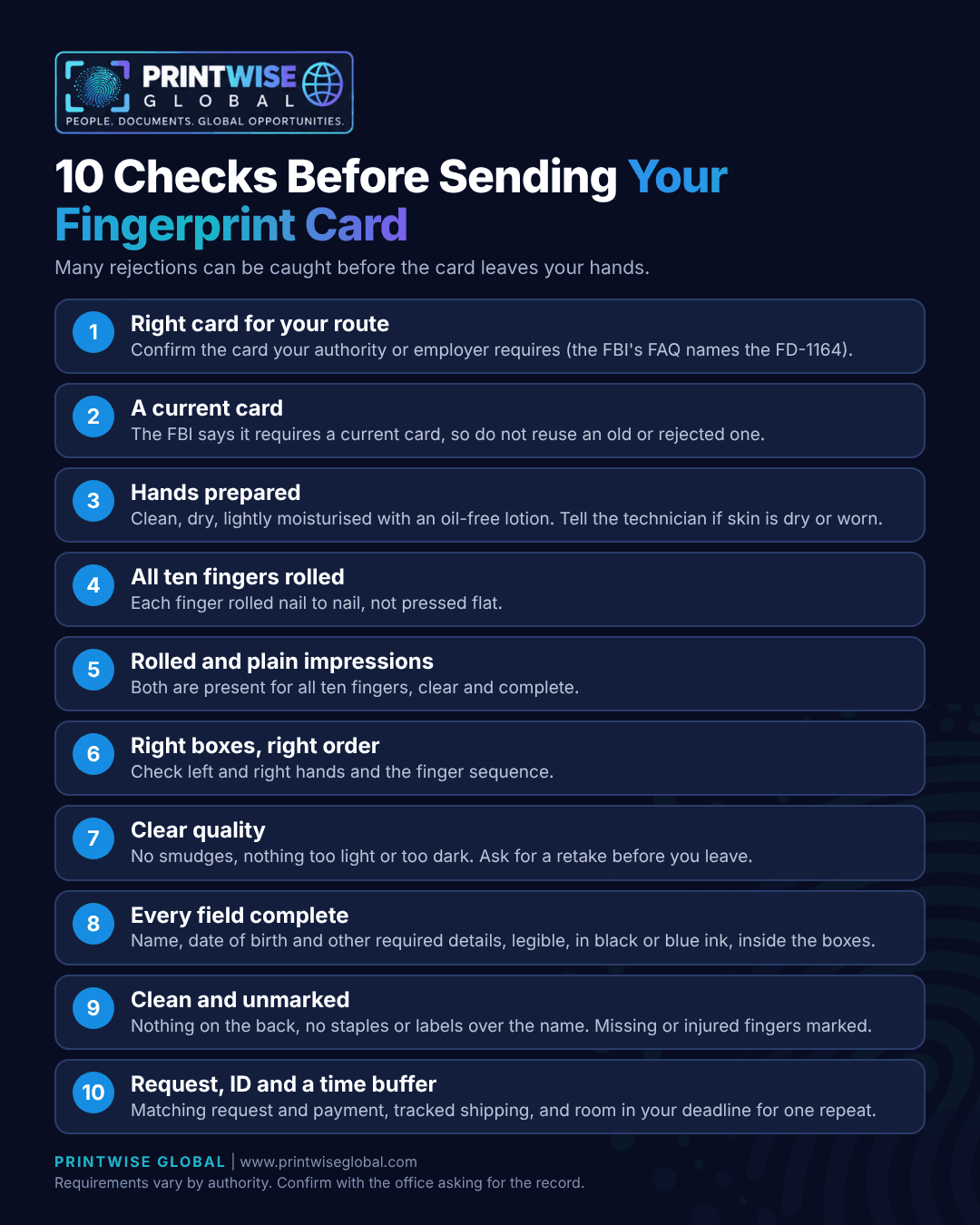
Before you book
- Confirm which country's record is required and which authority will receive it
- Confirm which card or format your route accepts. For an FBI Identity History Summary request you send yourself, the FBI's FAQ says it accepts FD-1164 cards on standard white paper stock; a receiving organisation may specify its own card. Our FD-258 guide explains the difference
- Ask whether you must bring your own card and whether the technician has experience with that format
- Avoid booking close to a deadline. Leave time for one repeat
In the days before
- Keep your hands moisturised, using a light, oil-free lotion rather than a heavy cream
- Avoid activities that wear down fingertips, and avoid harsh chemicals where you can
At the appointment
- Bring a valid photo ID, the correct card if one is needed, and any reference paperwork from the requesting organisation
- Wash and dry your hands first, and let the technician know if your skin is dry or your fingertips are worn
- Ask for unclear impressions to be retaken on the spot, before you leave
For more on the appointment itself, see how to prepare for an ink fingerprinting appointment.
Before the card is sent
- Check that every field is complete and legible, and that all ten fingers are rolled and in the right boxes
- Keep the card flat, unmarked, and in a protective envelope
- Send it with the correct request and payment, using a trackable service. Unsure who can send it for you? See Can Someone Submit My Fingerprint Card for Me?
What to Do After an FBI Fingerprint Rejection
- Find out why. Ask the authority or provider whether the problem was print quality, the card, or a missing detail
- Don't reuse the rejected card. The FBI's FAQ says it requires a current fingerprint card, so confirm what the authority needs before sending anything again
- Use a technician. If your prints keep being rejected, the FBI advises having multiple sets taken, preferably by a fingerprinting technician
- Tell the receiving office about the delay. If a deadline is at risk, an early message is better than a missed date
- Ask what alternatives exist. Some programs have fallback options after repeated rejections. For example, Washington State's agency describes a name-based check after a second FBI rejection. The FBI describes its own Name Check for prints rejected twice for image quality as limited to agencies with legal authority to submit fingerprints, so don't assume you can request one yourself
Tips for HR and Global Mobility Teams
- Give candidates written instructions. State the check, the card, the authority, and the deadline in the offer or onboarding pack
- Build in a buffer. Plan the start date with room for one repeat, not just the best case
- Standardise by country. Keep a short internal list of which check and route applies in each country you hire in
- Offer support. An appointment near the candidate, with someone who knows the card, avoids many avoidable repeats
- Track the whole chain. Fingerprinting, submission, apostille, and translation should be one timeline, not four separate tasks
Our guides to apostille vs attestation vs legalisation and the FBI background check apostille timeline and cost explain the steps that follow the check. For comparing systems, our RCMP guide includes a side-by-side FBI vs RCMP comparison.
How Printwise Global Helps
Printwise Global helps applicants and employers work out which check applies, offers professional fingerprinting by appointment where we cover your location, confirms the card and format before any prints are taken, and guides you through submission, apostille, and translation steps where they apply.
Frequently asked questions
It means the submission cannot be processed as sent, either because the impressions are not clear or complete enough, or because the card or its details are incorrect. It is not a finding about the applicant's record.
Common reasons include prints that were not fully rolled, smudged or too light impressions, dry or worn skin, prints out of sequence, a wrong or non-standard card, and missing or misplaced details. The authority or provider can usually tell you which applied.
No. A rejection concerns the quality of the prints or the form, not the content of any record.
Yes. Dry, thin, or worn skin can make prints harder to capture. Washington State's agency lists chemical exposure, thin or smooth skin, and worn ridges among the causes. Tell your technician beforehand and prepare your hands.
The FBI says it requires a current fingerprint card, so a rejected card should not simply be sent again. Confirm with the authority handling your request before resubmitting.
It depends on the authority, the time to re-take the prints, shipping in both directions, and the agency's current processing times, which are set by the authorities and can change. Check the current guidance for your route and leave time for at least one repeat.
Confirm the card and route first, use an experienced technician, prepare your hands, check that all ten fingers are rolled and in the right boxes, complete every field legibly, and send the card flat and unmarked.
Yes. A second submission can also be rejected if the print quality or card details remain inadequate. Ask the authority for the specific reason and have a qualified technician review the next set.
Printwise Global offers fingerprinting by appointment where we cover your location. Coverage and appointment times vary, so check availability for your address when you book.
The Printwise Team
Identity Verification Specialists
Printwise Global is an international identity-verification company providing certified fingerprinting, FBI and RCMP background checks, apostille, and certified translation. Our specialists manage cross-border document requirements end to end for clients across the USA, Canada, the UK, India, and beyond.

